Easter Sunday burglary and police search of the Secret Annex
Diary of Anne FrankThe Easter Sunday burglary and police search of the Secret Annex turned a break-in below the hiding place into a near-discovery above it. When Peter van Pels’s warning brought the men downstairs, they encountered burglars in the warehouse; after the intruders fled, a man and woman with a flashlight appeared, and the residents retreated behind the bookcase. During the ensuing search, footsteps reached the concealed entrance and the bookcase was rattled, but it was not opened. The residents survived the immediate danger, though the incident exposed how easily ordinary activity in the building could place them and their helpers at risk.
A hiding place made vulnerable
The Annex occupied part of the office building where Otto Frank worked. Its concealed entrance and the residents’ safety depended on separating their hidden quarters from the warehouse and the daily business below. That arrangement made concealment possible, but also meant that a breach of the warehouse could bring strangers into the same building. The residents already had rules for such emergencies: remain quiet, avoid using water, dress by a set time, and stay out of sight. Their safety rested not only on the hidden rooms but on the careful coordination of everyone in and around the office.
The break-in came against a broader history of restrictions and danger. Under German occupation, anti-Jewish decrees had curtailed where Jews could go, when they could be outside, and what public activities they could take part in. The Frank family had entered hiding earlier than planned after Margot received a call-up notice, and their refuge depended on the help of trusted office workers. The Easter incident brought those pressures into sharp focus: the residents were concealed, but neither the building nor the people assisting them were insulated from discovery.
From warning to confrontation
On Sunday evening, Peter van Pels knocked and asked Otto Frank to help him with a difficult English sentence. Anne Frank suspected that the request was a pretext. She inferred from the way the men were speaking that something was wrong downstairs, and the suspicion was borne out: the warehouse was being broken into. Otto Frank, Hermann van Pels, and Peter went down, while Anne, Margot, Edith Frank, and Auguste van Pels waited upstairs.
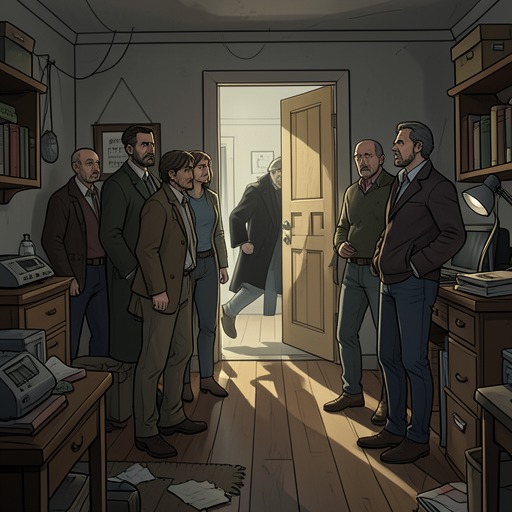
A bang below intensified the uncertainty. At ten o’clock, Otto Frank returned pale and nervous, told the residents to turn out the lights and go upstairs, and warned that they were expecting the police. The men went back down before they could explain what had happened. When they returned, they described how Peter, on the landing, had heard two loud bangs and seen a large panel missing from the left half of the warehouse door. He alerted the others, and the four men went into the warehouse while the burglars were still there. Hermann van Pels shouted that the police were present; the burglars ran out.
The apparent escape did not end the danger. The men replaced the panel in the door, but a kick from outside sent it back to the floor. The intruders’ boldness, and the sudden exposure of the warehouse, left the residents facing a risk they could not control. The episode moved rapidly from a break-in to a confrontation and then to a search for a safe place before anyone could establish who was outside.
The search at the bookcase
A man and a woman shone a flashlight through the opening, illuminating the warehouse. The four men ran upstairs; Peter opened doors and windows in the kitchen and private office, and the group eventually gathered behind the bookcase. The hurried retreat was an effort to make the office appear ordinary and the hidden entrance unremarkable. The residents did not know whether the people outside had alerted the police, but they had reason to fear that help might arrive before they could leave the building or restore the scene.
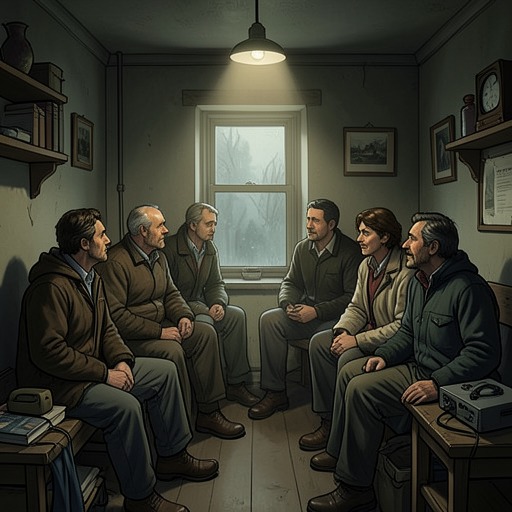
Because the next day was Easter Monday and the office would be closed, the residents expected to remain confined until Tuesday morning. They sat in darkness and whispered, listening for sounds from below. At eleven-fifteen, noise returned. The footsteps passed through the house, the private office, and the kitchen, then came up the stairs. The residents heard the bookcase rattle. Anne believed that all fifteen people in hiding would be taken away by the Gestapo that night. The footsteps eventually receded, and a can fell, but the search did not lead to the concealed rooms. A light left shining on the landing in front of the bookcase prolonged the uncertainty: the residents could not tell whether it signaled suspicion or had simply been forgotten.
The search’s most frightening feature was its proximity to the hidden entrance. The bookcase, ordinarily a barrier that kept the secret out of sight, became the point at which the outside world seemed to test that concealment directly. The diary records not a confirmed identification by the searchers, but the residents’ fear as they interpreted each sound and waited to learn whether the entrance would be opened.
Help arrives and precautions change
When Miep and Jan Gies returned, a knock at the bookcase was followed by Miep’s whistle, identifying the visitors to the residents. Jan nailed a pinewood board over the gap in the warehouse door, then left with Miep to inform the police of the burglary. Miep had also found a note beneath the warehouse door from Sleegers, the night watchman, who had noticed the hole and alerted the police. The helpers’ arrival brought relief, but it also showed that the danger involved those assisting the people in hiding: Anne explicitly feared for the Christians who were helping them.
The residents had only half an hour to put themselves and the rooms in order. Margot and Anne prepared the beds and washed, while others cleared the evidence of their enforced confinement and restored the household routine. This quick change from hiding in fear to making the rooms appear normal was part of the practical work of concealment. The incident did not end with the burglars’ departure; it left the residents having to consider what could happen if the warehouse were entered again, or if the people investigating it looked more closely at the office.
New precautions followed. Fritz Pfeffer was to work in the bathroom, and Peter was assigned to patrol the house between eight-thirty and nine-thirty. He was no longer allowed to open his window after someone from the Keg company had noticed it. The residents could not flush the toilet after nine-thirty at night. Sleegers was hired as night watchman, and a carpenter from the underground was expected to make a barricade using the white Frankfurt bedsteads. The helpers also advised the residents not to go downstairs. They still needed to assess whether Sleegers could be trusted, whether dogs would bark at someone near the door, and how the barricade could be made effective. These measures translated one frightening episode into a revised system of daily restrictions and watchfulness.
Significance in the diary
The episode shows how the Secret Annex’s security depended on fragile routines, physical barriers, and the judgment of people who had to act without knowing exactly who was outside. Peter’s observation of the damaged door and the men’s decision to confront the burglars prevented the break-in from passing unnoticed, but their response also brought the hidden residents close to the potential search. Later, the residents’ stillness and the bookcase’s resistance to inspection became the difference between fear of discovery and actual exposure.
Anne’s account links the practical consequences to the larger injustice of hiding. The new patrols, limits on water and movement, and proposed barricade were not simply household adjustments; they were further obligations imposed on people already confined because they were Jews under Nazi rule. Yet the diary also preserves the role of the helpers as active participants: Jan repaired the door, Miep and Jan dealt with the police, and the residents depended on them while fearing the danger their assistance brought. The burglary thus becomes more than an isolated intrusion. It reveals the precarious arrangement on which life in the Annex rested, and how a damaged panel below could place every hidden person above it in jeopardy.